

Marine funeral protocols: a dignified farewell at sea
TL;DR:
- Marine funerals are legal and regulated under U.S. federal guidelines, ensuring environmental safety.
- Families can personalize ceremonies through private providers, with no prior permits required.
- Protocols focus on biodegradable materials, proper location, and timely EPA notification.
Many families assume burial at sea is either unregulated or impossibly complicated. Neither is true. In reality, a clearly defined set of federal guidelines makes marine funerals not only legal but accessible to nearly any family in the United States. Whether you are planning ahead or arranging a farewell on short notice, understanding these protocols removes the guesswork and replaces it with confidence. This article walks you through every essential step, from legal requirements to personalization opportunities, so you can focus on what matters most: honoring your loved one with the dignity and beauty they deserve.
Table of Contents
- What is a marine funeral? Traditions, options, and misconceptions
- Core protocols: Federal requirements and essential rules
- Civilian vs. military burial at sea: Key differences explained
- Preparation and environmental considerations
- Navigating logistics: Booking, locations, and final touches
- A fresh perspective: Why protocol empowers personalization
- How Maritime Burials at Sea can support your journey
- Frequently asked questions
Key Takeaways
| Point | Details |
|---|---|
| Strict protocols ensure respect | Following federal guidelines safeguards both dignity and the marine environment. |
| Military and civilian rules differ | Navy burials follow unique procedures that families should review separately from civilian options. |
| Biodegradable materials required | Only natural and biodegradable materials are permitted for remains and tributes. |
| Personalization is possible | Despite clear regulations, families can craft a personalized, meaningful farewell at sea. |
What is a marine funeral? Traditions, options, and misconceptions
A marine funeral, often called a burial at sea, is a ceremony in which the remains of a loved one are committed to the ocean. This tradition stretches back thousands of years, practiced by seafaring cultures from ancient Scandinavia to the Pacific Islands. In the United States, it carries deep meaning for veterans, naval officers, coastal communities, and anyone who felt a profound connection to the water.
Today, marine funerals come in several forms. Ash scattering is the most common civilian option, where cremated remains are scattered directly onto the ocean surface or placed in a biodegradable urn that dissolves naturally. Full-body burial is far less common in civilian practice and involves stricter depth and preparation requirements. Military families may access the Navy’s formal program, which is distinct from private civilian ceremonies. You can explore the different at-sea ceremony types to understand which format fits your family’s wishes best.
Some of the most common misconceptions about marine funerals include:
- “It’s illegal or unregulated.” Not true. The EPA governs all burials at sea under the Marine Protection, Research, and Sanctuaries Act.
- “It harms the environment.” When done correctly with biodegradable materials, it is one of the most environmentally considerate farewell options available.
- “Only military families can do it.” Civilians have full access to personalized funeral options through licensed private charter services.
- “You need special permits in advance.” No prior permit is required for most families.
As the EPA confirms, burial at sea is permitted for both cremated and non-cremated remains when protocols are followed. Today, families from all walks of life choose marine funerals for their serenity, their environmental values, or simply because a loved one always found peace near the water.
“The ocean does not just receive our loved ones. It holds them in a space that feels boundless, timeless, and truly at rest.”
With the context in mind, it’s important to understand the official protocols that make a burial at sea possible.
Core protocols: Federal requirements and essential rules
After understanding traditions and options, let’s break down the rules that families and service providers must follow. The EPA administers the general permit that governs all civilian burials at sea in the United States. No application or prior approval is needed, but specific conditions must be met.
| Requirement | Cremated remains | Non-cremated remains |
|---|---|---|
| Minimum distance from shore | 3 nautical miles | 3 nautical miles |
| Minimum water depth | Any depth | 600 feet (1,800 feet in some FL areas) |
| Materials allowed | Biodegradable only | Biodegradable only |
| Post-event notification | Within 30 days | Within 30 days |
Here is a step-by-step overview of what the process looks like:
- Choose your location. Select ocean waters that meet the distance and depth minimums.
- Prepare the remains. Use only biodegradable materials. No plastics, synthetic fabrics, or non-decomposables.
- Conduct the ceremony. Scatter ashes, place the urn, or commit non-cremated remains according to preparation guidelines.
- Notify the EPA. Report the burial within 30 days using the EPA’s notification process. This is done after the ceremony, not before.
The EPA general permit specifies that cremated remains must be scattered at least 3 nautical miles from shore in ocean waters of any depth. Non-cremated remains require the same 3 nautical miles of distance plus a minimum depth of 600 feet, with 1,800 feet required in certain Florida areas. Biodegradable materials are the only option, and no plastics are allowed at any stage.
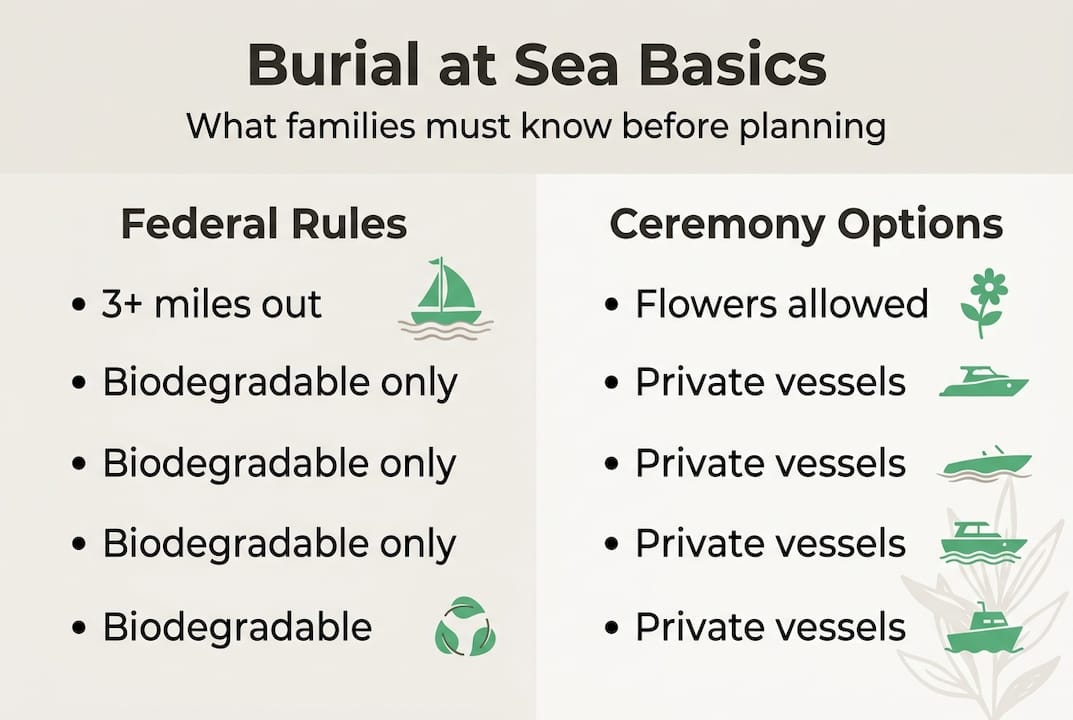
Federal rules apply across all U.S. ocean waters, but some states add their own considerations regarding permitted zones or vessel licensing. A reliable guide to sea burials can help you identify which rules apply in your specific coastal region.
Pro Tip: If you plan to scatter flowers or other ceremonial items alongside the remains, confirm every item is fully biodegradable. Even small synthetic decorations can trigger a compliance issue and make your EPA notification more complicated. Choosing certified eco-friendly memorials from a reputable provider eliminates this risk entirely.
Civilian vs. military burial at sea: Key differences explained
Once you know the general rules, it’s critical to understand which protocols apply to your loved one, especially for military families.
The U.S. Navy operates a formal Burial at Sea Program available to eligible uniformed service members, retirees, and veterans. The Navy Burial at Sea Program provides a free, dignified committal performed aboard Navy vessels at sea. However, the service is unattended by family members. Families receive a formal notification letter and a U.S. flag following the ceremony.
Eligibility for the Navy program typically includes:
- Active duty service members
- Retired military personnel
- Veterans with an honorable discharge
- Dependents of eligible service members in some cases
The VA confirms that Marines and other uniformed service members without a branch-specific program use the Navy’s burial program as their designated pathway. Requests involve submitting documentation through the appropriate mortuary affairs channel, and timelines can range from several weeks to several months depending on ship schedules and port availability.
| Feature | Navy program | Civilian private service |
|---|---|---|
| Family attendance | Not permitted | Yes, guests welcome |
| Cost | Free | Varies by vessel and services |
| Customization | Minimal | Highly personalized |
| Scheduling | Based on Navy schedule | Flexible |
| Location control | Designated ports only | Broader coastal access |
For families who want to gather together, share memories, and participate actively in the farewell, a civilian marine funeral aboard a private charter vessel is the more meaningful choice. The ability to include music, readings, flowers, and personal keepsakes transforms the event into a true celebration of life rather than a formal military commitment.
Preparation and environmental considerations
With protocols and eligibility understood, the next step is how to prepare both the remains and the ceremony itself.
For cremated remains, preparation is straightforward. The ashes should be placed in a fully biodegradable urn designed to dissolve in ocean water. The urn is either scattered directly or placed whole into the sea. No synthetic liners, plastic bags, or non-decomposable containers are permitted.

For non-cremated remains, the EPA specifies exact preparation requirements. Non-cremated preparation standards include wrapping the body in a natural shroud with appropriate weights, or using a casket that has at least twenty holes measuring two inches each, six steel bands, and an additional weight of 300 pounds to ensure proper sinking. No materials that resist decomposition may be included.
Here is a practical preparation checklist:
- Confirm whether you are working with cremated or non-cremated remains and identify the applicable preparation requirements.
- Source all materials from a supplier who certifies biodegradability.
- Review your vessel’s storage and loading capacity to ensure remains and ceremonial items can be handled safely and respectfully.
- Coordinate with your service provider to confirm they are familiar with EPA guidelines.
- Prepare your EPA notification in advance so you can submit it promptly within the 30-day window following the ceremony.
Families who work with experienced providers of personalized maritime burials often find that preparation feels less daunting because a knowledgeable team handles material sourcing and compliance checks on their behalf.
Pro Tip: Do not wait until the day of the ceremony to confirm that all materials are biodegradable. Request written confirmation from every vendor supplying flowers, urns, or decorative items at least one week in advance.
Navigating logistics: Booking, locations, and final touches
After understanding the practical requirements, families must tackle logistics and add meaningful details that make the farewell truly memorable.
Booking a marine funeral typically involves selecting a licensed charter captain, confirming vessel size based on your guest count, and coordinating a departure time that suits both weather conditions and family schedules. Most providers recommend booking at least two to four weeks in advance, though some families plan further ahead.
Key logistics to address include:
- Vessel size and capacity. Choose a yacht or charter boat that comfortably accommodates your group. Smaller vessels suit intimate gatherings, while larger yachts allow for more guests and ceremonial space.
- Permitted departure locations. Most coastal U.S. cities have accessible ocean departure points, but the EPA guidelines prohibit ceremonies in inland waters, rivers, estuaries, marine sanctuaries without special permits, or within 3 nautical miles of shore.
- Travel time to the site. Depending on departure point and required depth or distance, plan for 30 to 90 minutes of travel time each way.
- Weather and seasonal planning. Spring and fall typically offer calmer seas in most U.S. coastal regions.
Personal touches make a significant difference. Many families choose to include live music, poetry readings, floating flower arrangements, or the release of biodegradable petals onto the water. Keepsakes such as memorial jewelry made from a small portion of ashes, or a framed photograph, give attendees something tangible to carry forward. Working with dedicated yacht memorial services ensures that these details are handled with the care and attention they deserve.
Pets and non-human remains are strictly prohibited under U.S. law, and full-body civilian burials remain rare due to stricter depth and preparation requirements. Planning with a specialist helps you navigate these edge cases without stress.
A fresh perspective: Why protocol empowers personalization
Here is something most people never consider: the regulations surrounding marine funerals are not obstacles. They are a framework that actually makes meaningful personalization possible.
When a family knows exactly what is required, and when a trusted provider handles compliance, the mental space that opens up is remarkable. Instead of worrying about legality, families can focus entirely on music, flowers, readings, and the moments that will be remembered for a lifetime. The rules create a container, and within that container, the ceremony becomes whatever your loved one deserves.
At Maritime Burials, we have seen firsthand how families who initially felt overwhelmed by regulations end up creating the most deeply personal farewells imaginable, precisely because they had clarity and support. Understanding the luxury burial market insights and drawing from a wide range of at-sea tribute ideas transforms what could feel like a complicated process into a genuinely beautiful experience. Protocol and personalization are not opposites. When handled well, they are partners.
How Maritime Burials at Sea can support your journey
Planning a marine funeral becomes far easier when you have an experienced team alongside you. Maritime Burials connects families with captain-led yacht charters, curated memorial products, and expert guidance through every compliance step.
Whether you need a vessel like the spacious Bertram motor yacht for up to 49 guests, biodegradable urns that meet EPA requirements, or a carefully chosen selection from our funeral flowers collection, every detail is available in one place. We believe your loved one’s farewell should be as meaningful and dignified as the life they lived. Let us help you turn protocol into peace of mind.
Frequently asked questions
How far from shore does a burial at sea need to take place?
In the U.S., all burials at sea must occur at least 3 nautical miles from shore, with additional depth requirements for non-cremated remains of at least 600 feet.
Can families attend a Navy burial at sea?
No. Navy burials at sea are conducted aboard naval vessels without family present, though a formal notification letter and flag are sent to the family afterward.
Are pets or non-human remains allowed in marine funerals?
No. U.S. regulations strictly prohibit the burial of pets or any non-human remains in ocean waters under the marine funeral framework.
What materials are allowed for marine funerals?
Only fully biodegradable materials are permitted for both remains and ceremonial items. Plastics and non-decomposables are banned at every stage of the ceremony.
Is a permit required before a burial at sea?
No prior permit is needed. However, EPA notification must be submitted within 30 days following the ceremony, not before.
Recommended
- Marine memorials: a guide to luxurious farewells at sea – Maritime Burials at Sea - Nationwide Service Provider
- Marine memorial traditions: honoring loved ones at sea – Maritime Burials at Sea - Nationwide Service Provider
- Types of at-sea ceremonies for meaningful farewells – Maritime Burials at Sea - Nationwide Service Provider
- Ocean farewell: guide to eco-friendly at-sea memorials – Maritime Burials at Sea - Nationwide Service Provider
