

How sea burials support healing and emotional closure
TL;DR:
- Sea burials provide a deeply personal and restorative alternative to traditional land memorials.
- Ocean settings promote emotional healing through natural calm, symbolism, and shared presence.
- Personalization and ongoing connection enhance grief processing and create meaningful remembrance.
Many families assume that healing after loss requires a traditional land ceremony, a graveside gathering, a fixed place to return to. But that assumption leaves out something powerful: the ocean. Sea burials offer a structured, deeply personal farewell that blends ritual, natural beauty, and shared experience in ways that land memorials rarely can. Research is beginning to confirm what grieving families have long felt intuitively. The sea does something to us. It calms, it opens, and it helps us let go. This guide walks through the psychological, environmental, and practical reasons why at-sea ceremonies are becoming a meaningful path to emotional closure.
Table of Contents
- Why rituals matter: The psychological role of memorials
- Sea burials explained: Ceremony mechanics and what to expect
- Nature’s influence: The healing power of the ocean setting
- Making it meaningful: Personalization, symbolism, and ongoing connection
- A deeper take: Why at-sea memorials resonate more than traditional farewells
- Explore personalized options for sea burials and lasting remembrance
- Frequently asked questions
Key Takeaways
| Point | Details |
|---|---|
| Rituals enable healing | Meaningful sea burial rituals bring families together and support emotional transition after loss. |
| Nature amplifies comfort | The soothing ocean environment provides unique therapeutic benefits for mourners. |
| Personalization deepens connection | Custom music, readings, and keepsakes make each sea burial memorable and healing. |
| Ongoing remembrance possible | Families get GPS coordinates for at-sea memorial sites, strengthening lifelong bonds. |
Why rituals matter: The psychological role of memorials
Grief is disorienting. One of the most destabilizing parts of losing someone is the sudden absence of structure. Rituals restore that structure. They give grief a shape, a time, a place, and a community. Without them, loss can feel formless and isolating, which is one reason prolonged grief is more common when families skip meaningful ceremonies altogether.
Memorials make grief visible. When a family gathers to honor someone, they are collectively saying: this person mattered, and this loss is real. That shared acknowledgment does something important for the people left behind. It validates the pain and creates space for it to be expressed rather than suppressed.
Marine memorial traditions have existed across cultures for centuries, and modern sea burials draw on that deep well of meaning. They blend ancient maritime customs with contemporary personalization, giving families a ceremony that feels both timeless and uniquely their own.
Here is what structured memorial rituals offer grieving families:
- Emotional visibility: Grief becomes something shared rather than carried alone
- Communal support: Family and friends transition through loss together, not in isolation
- Symbolic release: Physical acts like scattering ashes give grief a tangible expression
- Ongoing connection: Ceremonies create memories that families return to mentally for years
- Reduced isolation: Rituals signal to everyone present that mourning is both natural and necessary
As one grief resource puts it, shared memorial rituals create structure, make grief visible, and build communal remembrance, all of which are essential for transitioning through loss in a healthy way.
“Rituals don’t just honor the dead. They protect the living.”
The science supports this. Memorial rituals enhance well-being by strengthening social bonds and supporting emotional processing, with measurable improvements in both subjective well-being and prosocial behavior among participants. For families considering how to honor a loved one, this is not a small detail. The form of the ceremony genuinely affects the outcome of the grief journey.
Sea burials explained: Ceremony mechanics and what to expect
If you have never attended a sea burial, the process might feel unfamiliar. But it is more accessible and more moving than most people expect. Understanding what actually happens can help families feel prepared and present rather than anxious.
Here is a typical sequence for a yacht-based sea burial ceremony:
- Departure from the marina: Guests board the yacht and begin traveling to the designated offshore location, usually beyond three nautical miles from shore per EPA regulations.
- Opening words or readings: A captain, celebrant, or family member opens the ceremony with words that reflect the loved one’s life and spirit.
- Shared memories and music: Family members share stories, play meaningful songs, or read poems. This is often the most emotionally rich part of the ceremony.
- Ash scattering or urn placement: Ashes are scattered using biodegradable urns, released with flower petals, or placed in the water using other symbolic gestures.
- Closing reflection: The group takes a quiet moment together before the return journey.
- GPS coordinate recording: Families receive the exact location of the ceremony for future visits or tributes.
Pro Tip: Ask your charter provider in advance whether a celebrant or officiant is included, or whether you will need to arrange one separately. Having a designated person to guide the ceremony frees family members to simply be present.
The flexibility of personalized funeral options at sea is one of their greatest strengths. Families can shape the ceremony around their loved one’s personality, values, and wishes.
| Ceremony element | Customization options |
|---|---|
| Music | Live instruments, playlists, or silence |
| Readings | Religious texts, poetry, personal letters |
| Ash release | Biodegradable urn, flower petals, reef ball |
| Guest involvement | Open sharing, candle lighting, flower tossing |
| Keepsakes | GPS coordinates, memorial jewelry, photos |
As families who have experienced these ceremonies describe, yacht-based sea burials foster family bonding, reflection in serene natural settings, and symbolic release of ashes, all while providing GPS coordinates for ongoing connection. For guidance on the logistics, planning an ash scattering ceremony at sea covers everything families need to know before the day arrives.
Nature’s influence: The healing power of the ocean setting
The ceremony itself is only part of what makes sea burials so healing. The environment plays an equally important role. There is something about being on the water that changes how we feel, and that change is not just poetic. It is physiological.
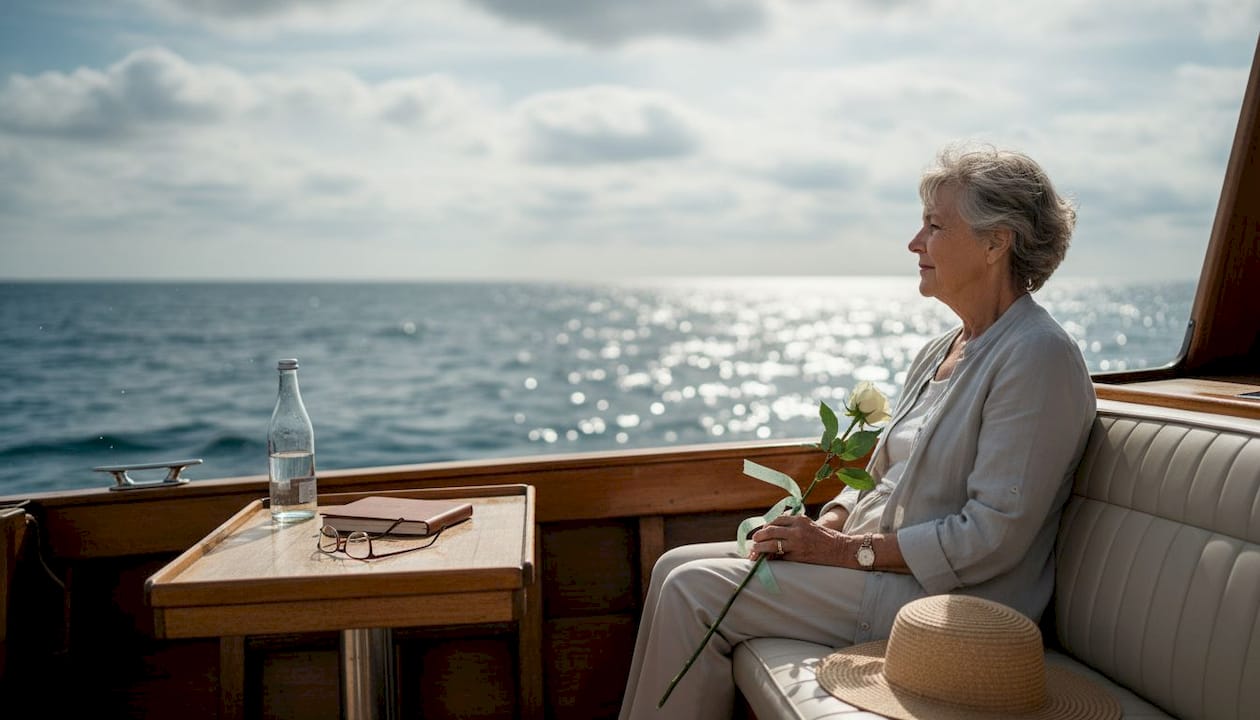
Research on blue spaces, which are environments near water, consistently shows that ocean proximity promotes calm, reduces stress hormones, and lifts mood. Sea gazing and ocean proximity promote well-being through calming, restorative experiences, and these effects extend meaningfully to sea burial settings. For families in acute grief, this matters enormously.
Pro Tip: If family members are prone to motion sickness, choose a calm weather window and ask your charter provider about vessel stability. A comfortable journey allows everyone to stay emotionally present rather than physically distracted.
Here is what the ocean environment specifically offers during a memorial:
- Privacy and space: Unlike cemetery services, a yacht ceremony is intimate and away from public view
- Natural rhythm: The movement of waves and wind provides a gentle, grounding sensory experience
- Visual openness: The horizon creates a sense of expansiveness that mirrors the emotional release of grief
- Symbolic resonance: Water has represented renewal, transition, and eternity across virtually every human culture
- Reduced formality: The natural setting softens the stiffness that can make land ceremonies feel clinical
Statistic to consider: Studies on blue space therapy show that even brief exposure to ocean environments can reduce cortisol levels and improve emotional regulation, effects that are particularly valuable when families are navigating the raw early stages of loss.
The serenity of yacht charters for memorial services adds another layer: the journey itself becomes part of the ceremony. Traveling together across open water, watching the coastline recede, and arriving at a meaningful location creates a shared experience that families remember long after the day is over.
Making it meaningful: Personalization, symbolism, and ongoing connection
A sea burial is not a one-size-fits-all event. The most healing ceremonies are the ones that feel unmistakably like that person. Their favorite music playing as the boat leaves the harbor. Their preferred flowers floating on the surface. A reading they loved, spoken by someone who loved them.
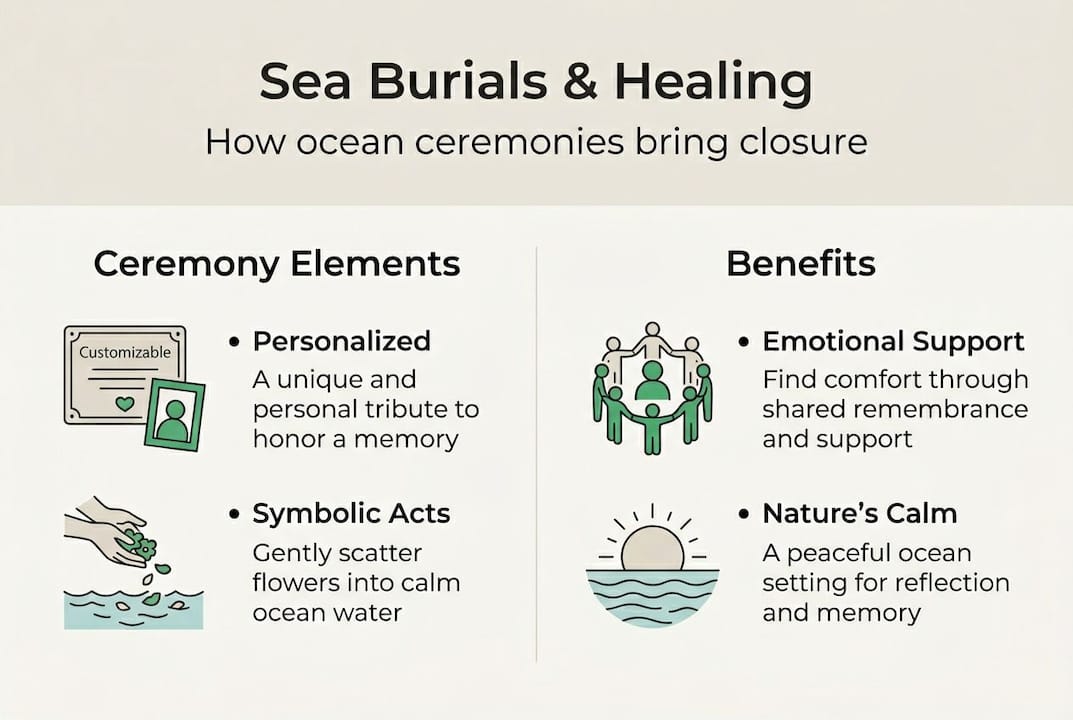
Personal touches do more than make a ceremony feel special. They deepen its emotional impact. When family members recognize their loved one in the details of the ceremony, it reinforces the reality of the loss while also celebrating the fullness of the life lived. That combination is what makes grief productive rather than paralyzing.
Symbolism in sea funerals runs deep, from the release of flowers as a gesture of farewell to the use of biodegradable urns as a commitment to returning to nature. These symbolic acts give family members something to do during the ceremony, which is important. Active participation helps people process emotions more effectively than passive observation.
| Approach | Standard ceremony | Personalized ceremony |
|---|---|---|
| Music | Generic or none | Loved one’s favorite songs |
| Flowers | Standard white | Preferred blooms and colors |
| Readings | Generic texts | Personal letters or poems |
| Ash release | Basic scattering | Biodegradable urn, reef ball |
| Follow-up | No coordinates | GPS for return visits |
Healing does not end when the boat returns to the marina. Unique memorial ceremony ideas extend remembrance beyond the day itself through keepsake jewelry, shared photo albums, and annual return trips to the GPS coordinates. These ongoing connections are not just sentimental. Research shows that meaningful rituals reduce prolonged grief, with studies finding that grief disorder rates dropped from 32% to 13.9% when participants engaged in satisfying, structured memorial practices.
The takeaway is clear: investing in personalization is not an indulgence. It is one of the most effective things a family can do for their collective healing.
A deeper take: Why at-sea memorials resonate more than traditional farewells
Most guides focus on logistics. What we have noticed, working with families across the country, is something harder to quantify: the quality of peace that families report after sea burials is different. Not just better. Different in kind.
Land memorials are fixed. The grave is there, the stone is there, and grief is anchored to a specific, unchanging place. For some families, that permanence is comforting. But for others, it can feel like grief itself is frozen.
The ocean moves. It changes with the light, the season, the weather. Families who return to the captained yacht charter options they used for the ceremony often describe the experience as alive in a way that a cemetery visit rarely is. The site is not static. And somehow, neither is the grief. It evolves, softens, and eventually becomes something closer to gratitude.
There is also the matter of participation. On a yacht, everyone is present in a way that is hard to replicate on land. There is no drifting to the parking lot, no checking phones. The water holds you there, together, in the moment. That shared presence is where real healing begins.
Explore personalized options for sea burials and lasting remembrance
If you are considering a sea burial for your loved one, the next step is finding a provider who understands both the emotional weight of the occasion and the practical details that make a ceremony run smoothly.
Maritime Burials offers customizable yacht charters for families of all sizes, from intimate gatherings to larger groups aboard a yacht for large memorials accommodating up to 49 passengers. You can also browse biodegradable urn options designed for respectful, eco-conscious ash scattering, and explore memorial keepsake jewelry to carry your loved one’s memory forward. Every detail can be tailored to reflect the person you are honoring and the healing your family needs.
Frequently asked questions
Are sea burials legal and safe?
Yes, sea burials that follow EPA offshore guidelines are fully legal and typically take place at least three nautical miles from shore to meet both safety and environmental standards.
Can we customize a sea burial ceremony to reflect our loved one’s personality?
Absolutely. Most sea burials are highly flexible, and families can choose music, readings, flowers, and keepsakes to create a ceremony that feels personal. Personalized yacht ceremonies are designed to reflect the individual, not a template.
Does having a sea burial help with the grieving process?
Research strongly suggests yes. Structured memorial rituals provide emotional support and communal remembrance, and studies show prolonged grief rates drop significantly when families engage in meaningful, satisfying ceremonies.
How do we stay connected to the memorial site after a sea burial?
Most providers record the GPS coordinates of the ceremony so families can return by boat to reflect, commemorate anniversaries, or simply feel close to their loved one again.
Recommended
- Step-by-step guide to sustainable burial at sea – Maritime Burials at Sea - Nationwide Service Provider
- Symbolism in sea funerals: traditions and eco options – Maritime Burials at Sea - Nationwide Service Provider
- Sea vs. land funerals: Choosing the right memorial – Maritime Burials at Sea - Nationwide Service Provider
- Top Reasons Families Choose Ocean Memorials for Unique Farewells – Maritime Burials at Sea - Nationwide Service Provider
