

How to Plan Intimate Ocean Memorials: A Step-by-Step Guide
TL;DR:
- Ocean memorials must be conducted at least 3 nautical miles from shore using biodegradable materials.
- Planning involves understanding EPA regulations, choosing eco-friendly materials, and selecting a suitable vessel.
- Personalizing ceremonies with meaningful rituals and guest participation creates lasting, healing farewells.
Honoring someone you love with a farewell at sea is one of the most powerful, personal choices a family can make. But between navigating federal regulations, coordinating a yacht, selecting biodegradable materials, and crafting every ceremonial detail, the planning process can feel overwhelming quickly. The good news is that an intimate, legally compliant, and genuinely beautiful ocean memorial is absolutely within reach. This guide walks you through every step, from understanding EPA requirements to designing a ceremony that reflects your loved one’s spirit, so you can focus on what matters most: saying goodbye with grace.
Table of Contents
- Understanding ocean memorial regulations and requirements
- Gathering materials and choosing your vessel
- Designing a personalized, memorable ceremony
- Carrying out the memorial and aftercare
- Rethinking the meaning of intimate ocean memorials
- Plan your ocean memorial with ease and care
- Frequently asked questions
Key Takeaways
| Point | Details |
|---|---|
| Legal requirements | Scattering must occur at least 3 nautical miles from shore using only biodegradable materials. |
| Preparation essentials | Gather all approved materials and carefully choose a luxury or eco-friendly vessel for your needs. |
| Personalization matters | Customize your ceremony with music, keepsakes, and meaningful rituals that align with ocean regulations. |
| Day-of protocol | Follow a checklist for ceremony flow and submit EPA notification within 30 days after the event. |
| Emotional closure | Prioritize memorable moments and aftercare to honor your loved one with peace and dignity. |
Understanding ocean memorial regulations and requirements
Before anything else, knowing the legal framework protects both your family and the ocean you’re honoring. The Environmental Protection Agency governs burial at sea in United States federal waters, and the rules are specific.
EPA regulations require ash scattering at least 3 nautical miles from shore, using only biodegradable materials, with notification submitted within 30 days of the event. These are not suggestions. They are federal requirements, and non-compliance can result in fines. The 30-day notification is straightforward, submitted directly through the EPA’s website, but families often forget it in the emotional aftermath of a ceremony.
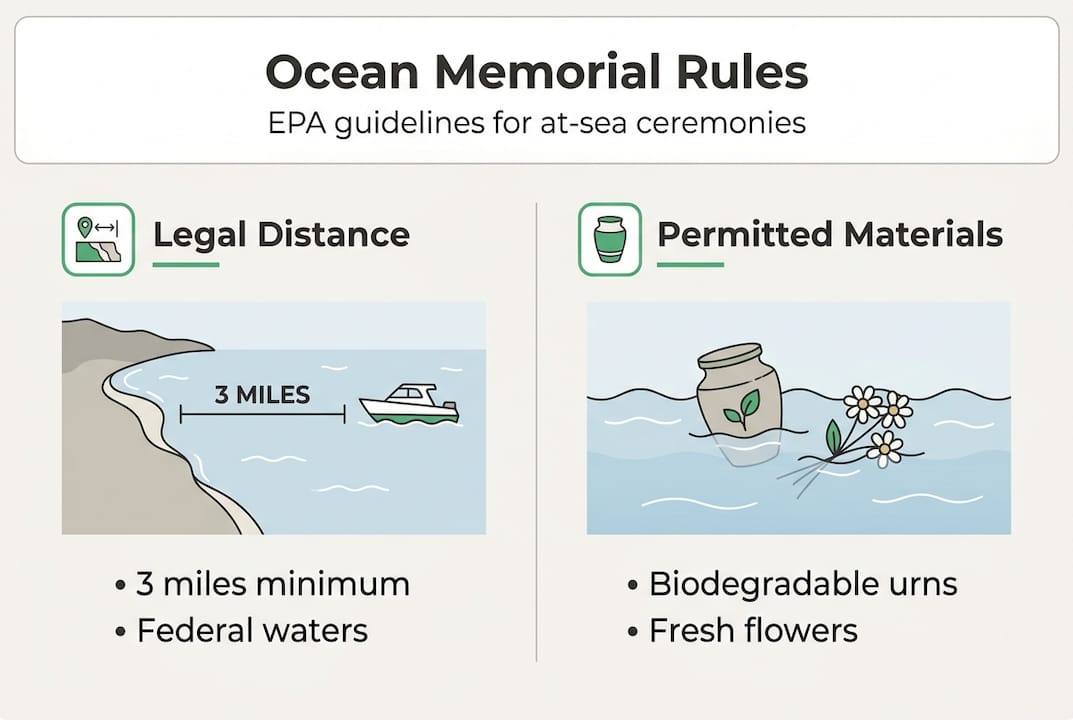
There are important edge cases too. No pets/human mix under EPA rules is a firm boundary. If you’re planning a combined memorial for a person and their pet, separate ceremonies are required. For full-body burials rather than ash scattering, the water must be at least 600 feet deep. And if you’re considering a service in inland waterways or coastal state waters, those are governed by individual state laws, which vary significantly.
One detail families consistently underestimate is wind. Ashes are fine and light, and an unexpected gust can create a distressing moment. Scattering tubes are specifically designed to release remains in a controlled direction, keeping the experience dignified for everyone on deck. Understanding eco-friendly memorials ahead of time helps you plan around these physical realities.
Key legal requirements at a glance:
| Requirement | Rule | Notes |
|---|---|---|
| Distance from shore | Minimum 3 nautical miles | Federal waters only |
| Materials | Biodegradable only | No plastics, synthetic materials |
| EPA notification | Within 30 days | Submit online via EPA portal |
| Full-body burial depth | 600+ feet | Different permit process |
| Pet/human ashes | Not permitted together | Separate services required |
| Inland water rules | State-regulated | Varies by state |
Common mistakes to avoid:
- Scattering ashes in state coastal waters without checking local law
- Using non-biodegradable flower arrangements or decorations
- Forgetting to submit EPA notification after the ceremony
- Not accounting for wind direction before releasing ashes
- Mixing remains without understanding the prohibition
- Underestimating travel time to reach the 3-nautical-mile boundary
“The ocean memorial process is legally manageable, but only when families understand the requirements in advance. Compliance is also a form of respect, for the water, the ecosystem, and the loved one being honored.”
Gathering materials and choosing your vessel
With legal requirements understood, the next step is assembling everything you need and selecting a vessel that matches the tone and scale of the ceremony you envision.

Ash scattering must use biodegradable materials and appropriate containers such as scattering tubes or urns per EPA guidance. This means every physical element of your ceremony, from flower petals to the urn itself, must break down naturally in salt water. The good news is that biodegradable options have evolved significantly. You can find beautifully crafted urns made from recycled paper, natural sand, or sea salt that dissolve gracefully. Flowers such as roses, carnations, and marigolds are all safe choices.
Beyond the urn, think about what keepsakes guests will take home. Small biodegradable seed packets, pressed flowers, or memorial jewelry created from a portion of the ashes are meaningful options that extend the ceremony’s impact beyond the water.
Choosing your vessel is equally important. The size of your guest list, the level of comfort you want to provide, and your commitment to sustainable practices all factor into this decision. Exploring luxury event options helps you understand what’s possible across different vessel types.
Vessel comparison for intimate ocean memorials:
| Vessel type | Guest capacity | Amenities | Sustainability notes |
|---|---|---|---|
| Small sailboat | 6 to 12 | Basic seating, quiet | Low fuel use, minimal wake |
| Motor yacht (40 to 60 ft) | Up to 30 | Full deck, seating, catering | Modern low-emission engines |
| Large charter yacht | 30 to 49 | Full hospitality, climate control | Best for larger family groups |
| Catamaran | 10 to 20 | Stable platform, open deck | Fuel-efficient design |
For most intimate services, a mid-size motor yacht strikes the right balance between comfort and accessibility. A professional captain experienced in memorial voyages will also know how to position the vessel for wind advantage during the scattering. If you’re considering renting a yacht charter for the first time, look for operators who specialize in memorial services rather than general charters.
Materials checklist:
- Biodegradable urn or scattering tube
- Fresh-cut biodegradable flowers
- Keepsakes for guests (jewelry, seed packets, photo cards)
- Printed programs or reading cards
- Sound system for music if desired
- Refreshments and seating for guests
Pro Tip: Always check the weather forecast 48 hours before and again the morning of the service. Wind above 15 knots can make ash scattering difficult and emotional for guests. Have a flexible rescheduling policy with your charter operator just in case.
Designing a personalized, memorable ceremony
With logistics settled, this is where the ceremony becomes truly yours. The most meaningful ocean memorials are the ones that feel specific to the person being honored, not generic or rushed.
Start by thinking about what your loved one valued. Did they love music? Choose two or three songs that meant something to them, either played live or through a speaker system on deck. Did they have a favorite poem, scripture, or piece of literature? Assigning a family member or close friend to read it aloud creates an intimate, human moment that no professional officiant can replicate.
Here is a step-by-step framework for building your ceremony:
- Opening words from a family member or captain to welcome guests and set the tone
- Music or a moment of silence as the vessel moves to the scattering location
- Readings or reflections from two or three people who knew the deceased well
- The scattering ritual with flowers placed on the water afterward
- A moment of remembrance where guests share a memory or say a private farewell
- Closing with a song, a prayer, or a toast in honor of the life lived
- Return journey with light refreshments, shared stories, and quiet reflection
EPA rules prohibit scattering any non-biodegradable items at sea, so all ceremonial elements must meet this standard. That means paper lanterns with wire frames are out, but biodegradable balloon releases or natural petal scattering are perfectly appropriate. For memorial keepsake ideas, think about small items guests can keep as a tangible connection to the day.
Many families are surprised by how much comfort the guest experience itself provides. Offering warm drinks, a light meal, or even a small photo display of the loved one on deck transforms a ceremony into a gathering. Understanding why families choose ocean memorials often comes down to exactly this: the shared, unhurried time together on the water.
Pro Tip: Assign one trusted person to quietly document the ceremony with photos or video. Brief them in advance on privacy boundaries, keeping phones away during the most sacred moments. A short edited video sent to family members who could not attend can be a deeply healing gift.
Carrying out the memorial and aftercare
The day of the ceremony calls for calm preparation. Having a clear sequence of events removes guesswork and lets everyone stay present.
Day-of ceremony checklist:
- Confirm departure time with the charter captain the evening before
- Arrive at the marina 30 minutes early to board, settle guests, and review the plan
- Brief the captain on the ceremony sequence and preferred scattering location
- Distribute programs, keepsakes, and any items guests will hold during the service
- Begin the ceremony once the vessel reaches the 3-nautical-mile boundary
- Follow the planned order, allowing natural pauses and emotional moments
- Complete the scattering with flowers placed on the water
- Allow 10 to 15 minutes of open, quiet time before beginning the return
- Document the GPS coordinates, time, and date of the scattering for EPA notification
After the ceremony, the EPA notification process is simple but time-sensitive. EPA requires notification within 30 days of ash scattering at sea. You’ll need the date, location, and type of remains scattered. Most charter operators experienced in memorial services will help you gather this information before leaving the vessel.
“The return journey is often the most underestimated part of an ocean memorial. Families who plan for a gentle, unhurried trip back to shore, with refreshments and space to talk, consistently report feeling a sense of peace and closure that land-based services rarely provide.”
For unique at-sea farewells, many families choose to continue honoring their loved one in the weeks after the service. Ordering a custom memorial piece, planting a tree, or organizing an annual gathering on or near the water are all meaningful ways to keep the connection alive. Grief doesn’t end at the dock, and the rituals you build around that can be just as important as the ceremony itself.
Rethinking the meaning of intimate ocean memorials
Here’s something the funeral industry rarely talks about openly: smaller, more deliberate ceremonies tend to be more healing than large, formal ones. There is real emotional science behind this. When a group is small enough that every person knew the deceased, the shared grief becomes communal rather than performative.
The legal structure around ocean memorials, which many families initially view as an obstacle, actually serves a hidden purpose. Working through EPA requirements, selecting biodegradable materials, and coordinating a proper vessel forces families to be intentional. That intentionality is itself a form of honoring someone.
We’re also watching a clear shift in what families want. More people are asking for eco-friendly and meaningful farewells that reflect their values, not just tradition. The ocean memorial is growing because it delivers something traditional funerals struggle to offer: a living, moving, breathing environment that mirrors the enormity of loss and the beauty of a life fully lived. Intimacy amplifies all of that.
Plan your ocean memorial with ease and care
When you’re ready to take the next step, having the right support makes all the difference. Maritime Burials connects families with captain-led yacht charters, eco-conscious ceremonial products, and personalized guidance so nothing is left to chance.
Explore a semi-custom luxury yacht that accommodates up to 49 guests with full onboard amenities, or browse a curated selection of biodegradable urns designed to dissolve beautifully in ocean waters. For guests who want a lasting keepsake, keepsake jewelry offers a wearable, intimate tribute. Every detail is handled with care, so your family can simply be present for the farewell your loved one deserves.
Frequently asked questions
How far from shore must a burial at sea be performed?
Ash scattering must happen at least 3 nautical miles from shore under federal EPA rules, which apply in United States territorial waters.
What materials are allowed for ocean memorials?
Only biodegradable materials are permitted, including natural urns, fresh flowers, and eco-friendly keepsakes that break down naturally in salt water.
Can you combine pet and human ashes in a sea burial?
No, mixing human and pet remains is not permitted under EPA regulations, and separate ceremonies are required for each.
Are permits or notifications required for ocean memorials?
No permit is needed for ash scattering, but you must notify the EPA within 30 days after the ceremony with the date and location of the scattering.
How do I prevent ashes from blowing back onto the vessel?
Use a scattering tube and always release ashes downwind of the vessel to keep the experience safe and dignified for all guests on board.
Recommended
- Ocean farewell: guide to eco-friendly at-sea memorials – Maritime Burials at Sea - Nationwide Service Provider
- How sea burials support healing and emotional closure – Maritime Burials at Sea - Nationwide Service Provider
- Top Reasons Families Choose Ocean Memorials for Unique Farewells – Maritime Burials at Sea - Nationwide Service Provider
- Marine memorial traditions: honoring loved ones at sea – Maritime Burials at Sea - Nationwide Service Provider
- Infinite Roses - Create a Lasting Memory – OnlyRoses - UK
- What I Learned at a Funeral
